Global Recognition for Nigeria Customs as ‘Customs Cares’ CSR Initiative Wins Commonwealth Gold Award

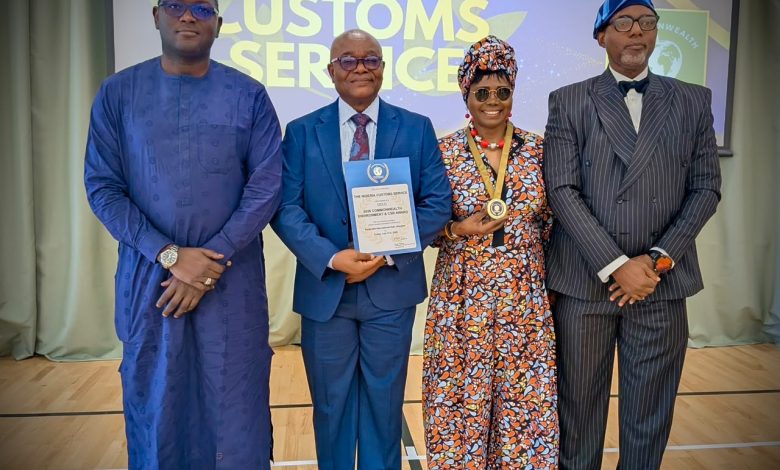
The Nigeria Customs Service (NCS) has received global recognition as its flagship Corporate Social Responsibility (CSR) initiative, Customs Cares, won the Commonwealth Environment and CSR Gold Award in Glasgow, Scotland on Friday, 31 July 2026.
The award honours organisations with measurable, sustainable and community-driven interventions that advance the United Nations Sustainable Development Goals. Customs Cares stood out for its impact in education, healthcare, food security, and environmental sustainability across Nigeria.
Receiving the award on behalf of the Comptroller-General of Customs, Adewale Adeniyi, MFR, Deputy Comptroller-General of Customs (DCG) in charge of Enforcement, Investigation and Inspection, Timi Bomodi described the recognition as a defining milestone in the Service’s transformation journey.
“This award is both humbling and inspiring. It affirms our belief that public institutions create their greatest value not only by fulfilling their statutory mandates, but by improving lives and strengthening the communities they serve,” he said.
Adeniyi attributed the honour to President Bola Ahmed Tinubu’s Renewed Hope Agenda. He said Customs Cares has reached over 10 million Nigerians in 12 states and the Federal Capital Territory, through school renovations, healthcare projects, clean water, food support and the Green Borders Initiative. “Beyond every classroom renovated, every borehole commissioned and every tree planted is something even more enduring; trust,” he added.
The Governor of Tharaka Nithi County, Kenya, Muthomi Njuki, also spoke on climate action and partnerships. “No country could solve the crisis alone, but that through accountability, partnership, innovation and shared responsibility, the world could become greener, safer and more prosperous,” he said.
The Comptroller in charge CSR, Mbwiduffu Ibrahim, said the recognition would spur the Service to do more. “For a long time, we worked believing that the impact in our communities was reward enough. Today, this international recognition tells us that those efforts have not gone unnoticed,” she said.
The organisers noted that NCS won for its innovative Hub-and-Spoke Community Activation Model. They added that the award reinforces NCS’ reputation as a modern Customs administration committed to revenue generation, trade facilitation, border security, and sustainable development.